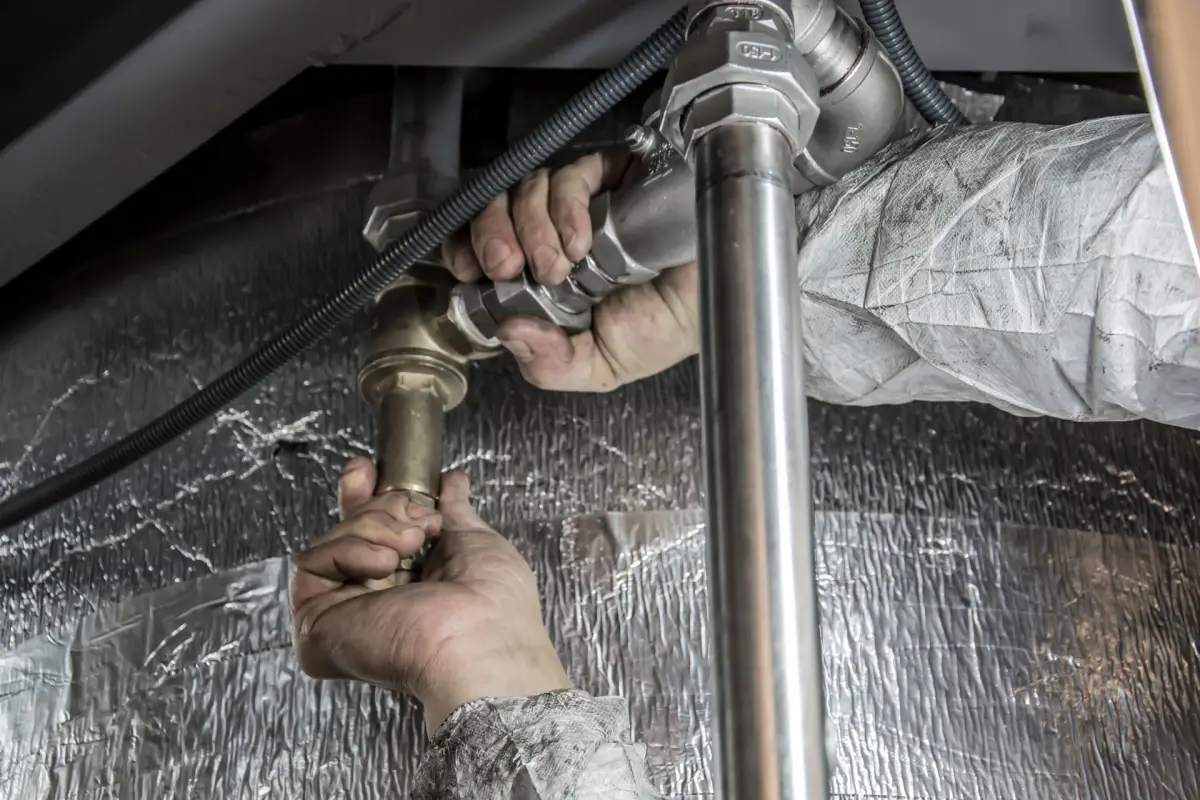
Lofts are out of sight, cold in winter and often packed with insulation, which makes them a good place for a leak to go unnoticed. By the time anyone looks, the water has usually soaked the insulation and reached the ceiling below. The source is normally one of a short list: the cold water storage tank, the valve that fills it, its overflow, or the pipes that run across the loft.
This guide explains how to read the signs, how to tell the causes apart, and what to shut off first.
What in the loft can leak?
- The cold water storage tank, which feeds a vented hot water cylinder and often some cold taps and toilets.
- The feed and expansion tank, a smaller tank that tops up an open-vented heating system.
- The float-operated valve, usually called the ballvalve, which refills each tank.
- The overflow or warning pipe, which carries water outside if a tank overfills.
- Tank connectors where pipes pass through the tank wall.
- Pipes, including the rising main to the tank, the pipes from the tank down to the house and the vent pipe from the cylinder.
- A boiler, in some homes, with its own pipework and pressure relief pipe.
Not every loft leak is plumbing. Water that appears only after rain is more likely to be the roof.
What are the signs of a leak in the loft?
- a stain on the ceiling of a top-floor room or landing, often near the loft hatch or below the tank;
- water dripping from a ceiling light fitting;
- a ceiling that bulges or sags;
- wet or compressed insulation around the tank;
- water running from the overflow pipe outside the house;
- the sound of the tank filling when no water is being used;
- a meter that keeps moving with everything turned off.
Water and electrics together are dangerous. If water is coming through a light fitting, switch that circuit off at the consumer unit, provided the consumer unit is dry, and do not use the light switch. Keep everyone out from under a bulging ceiling. Our guide to the first hour of a ceiling leak covers containment.
Is the cold water tank leaking or overflowing?
This is the first question to answer, because the fixes are very different.
| What you find | Likely cause |
|---|---|
| Water level at or above the overflow, water running from the overflow pipe outside | Ballvalve not shutting off |
| Tank overfilling but nothing coming out outside; water around the tank | Overflow blocked, disconnected or missing, with the ballvalve not shutting off |
| Normal water level, water around a pipe entering the tank | Leaking tank connector or joint |
| Normal water level, water under the tank with no joint wet | Split or corroded tank |
| Droplets on the outside of the tank and cold pipes, worse in cold weather | Condensation rather than a leak |
| Wet timber or insulation only after rain, often near the eaves or chimney | Roof leak |
Older galvanised steel tanks are prone to rusting through, often at the base or around connections. Plastic tanks can crack if they are not supported across their full base.
How does a faulty ballvalve cause a leak?
The ballvalve uses a float on an arm. As the water rises, the float lifts and closes the valve. It can fail to close if:
- the washer or diaphragm inside is worn;
- scale or debris is holding it open;
- the float has filled with water or come loose;
- the arm is bent or the float is catching on the tank or lid.
When that happens, water keeps entering the tank and leaves through the overflow. The Water Supply (Water Fittings) Regulations require storage cisterns to have an overflow with a warning of an impending overflow, so a pipe running outside is doing its job. It is telling you the valve needs attention. If the overflow has been disconnected, blocked or buried in insulation, the same fault floods the loft instead.
The regulations also call for a servicing valve on the inlet next to the cistern, a close-fitting cover, and screened overflow and warning pipes. If your tank has a servicing valve, closing it stops the tank refilling while the ballvalve is repaired.
Why do loft pipes freeze and split?
A well-insulated loft floor keeps heat in the house, which makes the loft itself colder. Pipes and tanks up there are exposed to that cold. When water in a pipe freezes, it expands and can split the pipe or push a joint apart. The leak often does not show until the ice thaws, which is why a burst is commonly discovered as the weather warms up.
Standard advice is to:
- lag all pipes in the loft, including overflow and vent pipes;
- insulate the top and sides of the tank;
- leave the loft floor directly under the tank uninsulated, so warmth from the rooms below helps keep the tank from freezing;
- check that insulation has not been pushed away from pipes when things were stored in the loft.
Our leak prevention page covers winter checks in more detail.
What should you do if the tank or loft pipes are leaking?
- Make the electrics safe in the rooms below if water is near lights or sockets.
- Close the main stopcock. This stops the tank refilling, but it does not empty what is already in it.
- Close the servicing or gate valve on the pipe leaving the tank if the leak is on the pipework below it.
- If the tank itself is leaking, drain it down. Switch off the boiler and immersion heater first, then run the taps fed from the tank. In many homes these include the bathroom cold taps and the hot taps, but it varies, so check which taps slow and stop.
- Contain the water with buckets and towels in the loft and below. Step only on joists or boarded areas, never on the plasterboard between them.
- Photograph the source and the damage.
If a pipe has split and you need water back on before a plumber can attend, our guide to a temporary fix for a leaking pipe explains the options and their limits.
How is a hidden loft leak found?
Most loft leaks are visible once you are up there with a torch. They become harder to find when:
- pipes run under loft boarding or deep in insulation;
- the leak is in the eaves or a part of the loft that cannot be reached safely;
- the stain below is well away from the tank, because water has run along a joist;
- it is not clear whether the water is from pipes, the roof or condensation.
In those cases, moisture mapping of the ceiling below, thermal imaging and pressure testing the pipework help separate the causes without lifting boards at random. If the stain below has no obvious source at all, our guide to a damp ceiling patch with no obvious leak covers the other possibilities.
When should you call a leak detection specialist?
A stuck ballvalve, a leaking tank connector or a split pipe you can see is a job for a plumber. Call a specialist when:
- the ceiling below is wet but nothing in the loft is visibly leaking;
- the meter keeps moving after the loft has been checked;
- you cannot tell whether the water is from the plumbing or the roof;
- pipework is hidden under boarding or in inaccessible eaves;
- you need the cause documented for an insurer.
A thermal imaging survey is £150 to £250, and a damp and moisture survey is £250 to £450. Call 020 3912 0200 to describe what you are seeing.
Frequently asked questions
Why is my cold water tank in the loft leaking?
The usual causes are a ballvalve that will not shut off, an overflow that is blocked or disconnected, a leaking connector where a pipe enters the tank, or a tank that has split or corroded. Checking the water level against the overflow tells you which group you are in.
Why is water coming out of the overflow pipe outside my house?
Usually because the ballvalve in a loft tank, or in a toilet cistern, is not closing properly. The overflow is doing its job by warning you. The valve needs a new washer, cleaning or adjusting.
Should I turn off the water if the loft is leaking?
Yes. Close the main stopcock to stop the tank refilling, and the valve on the pipe leaving the tank if the leak is below it. If the tank itself is leaking, drain it by running the taps it supplies, after switching off the boiler and immersion heater.
Can pipes in the loft freeze?
Yes. A loft above a well-insulated floor gets very cold. Lagging all pipes, insulating the top and sides of the tank, and leaving the floor directly under the tank uninsulated all help reduce the risk.
How do I know if a ceiling stain is from the loft tank or the roof?
Timing is the best clue. A stain that grows regardless of the weather points to plumbing. One that appears or grows after rain points to the roof. Moisture readings and checking the tank level help confirm it.